


Over three weeks in May, I visited a number of college campuses in the American Northeast—Princeton, Penn, Haverford, Bryn Mawr, Swarthmore, Georgetown. Different institutions, founded across different centuries, shaped by different religious and intellectual traditions. And yet, moving through them, a common feeling kept returning.
These campuses were not merely built to house education.
They were built to produce institutional gravitas.
Architecture is not ornamental to the university. It is part of the pedagogy. The soaring libraries, stone facades, Gothic towers, quadrangles and cathedral-like reading rooms are often described as beautiful or historic. But reducing them to aesthetics misses something more important. These campuses were designed to shape institutional psychology. They were meant to make students feel part of something older, larger and more enduring than themselves.
This was especially striking because many of these campuses belong to institutions founded in a relatively young country. Princeton was founded in 1746, Penn in 1740, Georgetown in 1789, Haverford in 1833, Swarthmore in 1864 and Bryn Mawr in 1885. America did not possess the centuries-old intellectual inheritance of Oxford, Sorbonne or Bologna.
And yet, by the late nineteenth century, many American universities had begun consciously borrowing from older European architectural traditions—particularly Gothic and Collegiate Gothic forms—to construct a sense of continuity, seriousness and historical weight.
Architecture became one way a young nation manufactured institutional gravitas faster than history alone could provide.
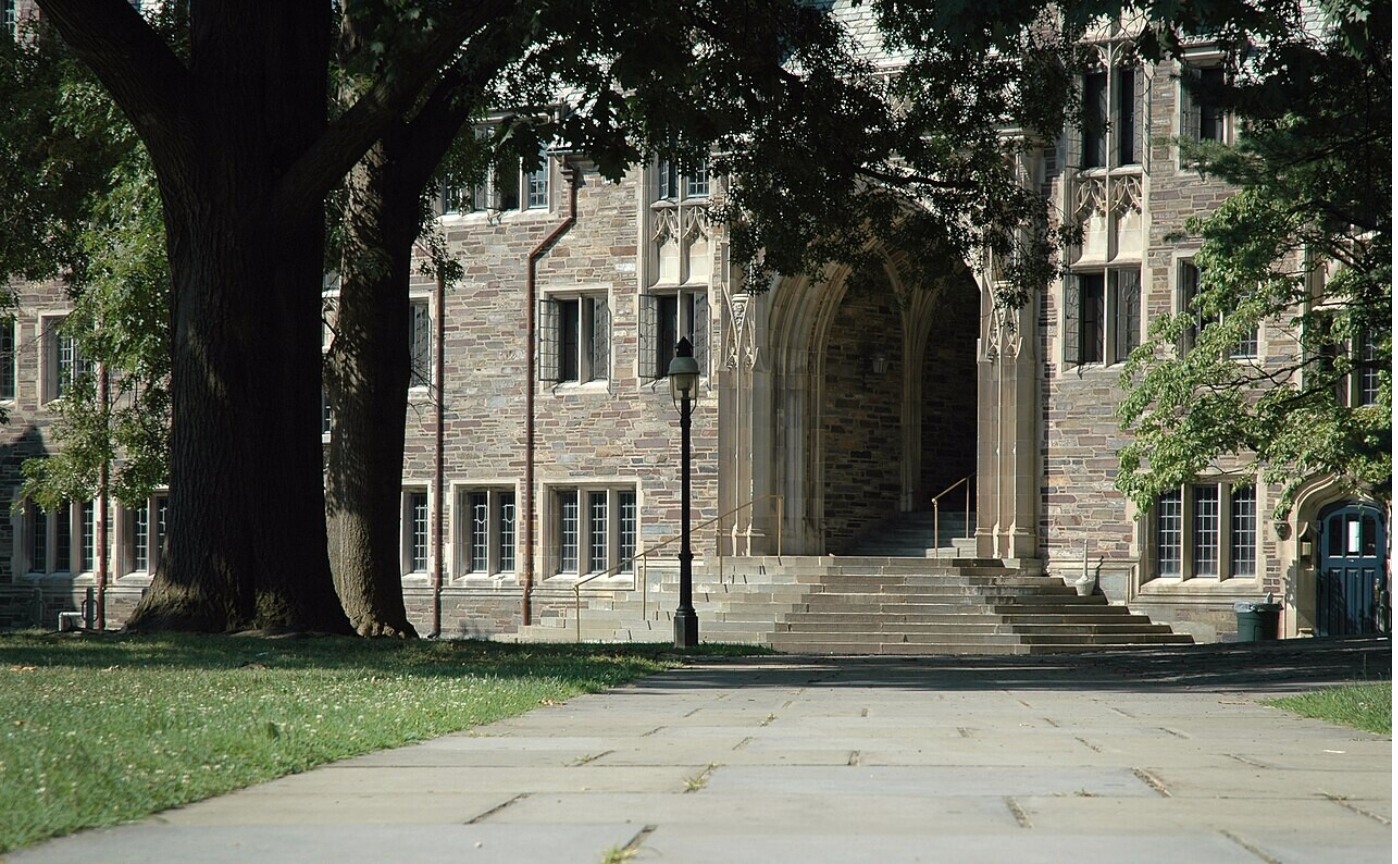
Architects such as Cope & Stewardson, who shaped major parts of Penn, Princeton and Bryn Mawr, were not merely designing buildings; they were designing institutional identity. The quadrangles at Penn, the cohesive Gothic language at Bryn Mawr and the monumental scale of Princeton were spatial expressions of what these institutions aspired to become. Their architecture communicated seriousness, endurance and intellectual authority—while also functioning as acts of elite signaling in a country still constructing its academic legitimacy.
At Princeton and Georgetown, the architecture often feels civilizational. Towers, arches and axial pathways create a sense of historical depth and authority. The student enters not simply a campus, but a tradition.
Haverford and Swarthmore feel different. Both emerged from Quaker educational traditions, and their campuses communicate seriousness without spectacle. The buildings are quieter, more integrated into landscape, less theatrically imposing, allowing nature and space themselves to become part of the educational atmosphere. At Swarthmore in particular, the arboretum-like setting and intimate academic spaces create a feeling of intellectual immersion rather than institutional performance.
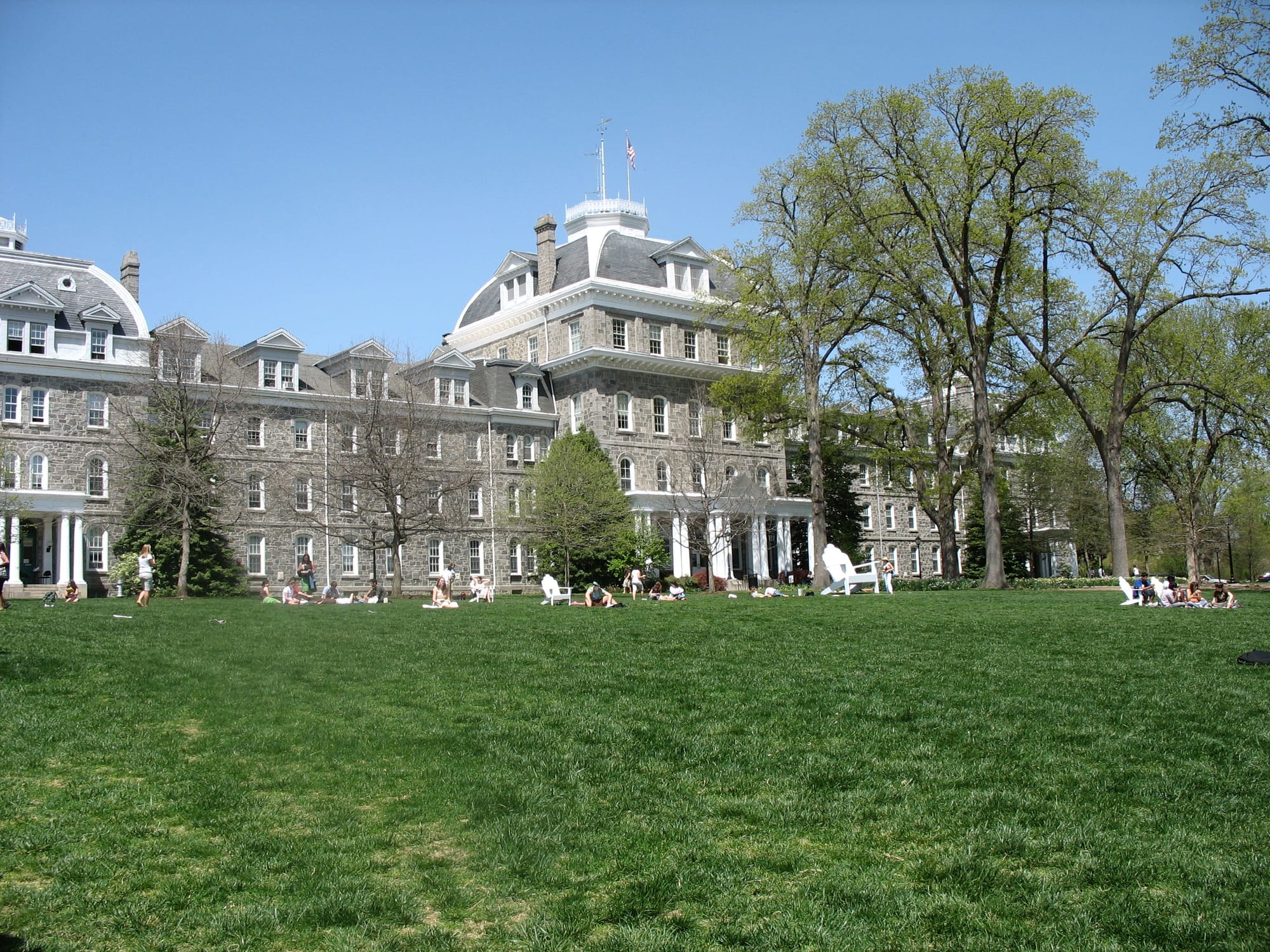
Great institutional architecture does not always require grandeur. It requires coherence between institutional philosophy and physical space.
Penn and Bryn Mawr also emerged from broader Quaker contexts, but by the late nineteenth century their ambitions had expanded beyond Quaker modesty toward elite academic identity and research legitimacy. Their embrace of Collegiate Gothic architecture was not incidental. It was part of a broader American project of constructing institutional seriousness through space itself.
India, too, has its own traditions of institutional architecture. Colonial-era universities such as Mumbai University and Calcutta University were designed with similar ideas of permanence and intellectual authority in mind, even if those visions emerged within a British imperial framework. Post-Independence India also produced powerful architectural expressions of educational ambition—from the modernist campus of IIT Kanpur to Louis Kahn’s iconic design for IIM Ahmedabad, and later the carefully designed academic environments of institutions such as IIM Bangalore and the ISB campus at Hyderabad.
But architecture alone does not create enduring institutional environments. They also require stewardship. One of the striking differences across many leading campuses abroad is that they often seem to improve with time: interiors are modernised, infrastructure evolves, student spaces are upgraded, while the larger architectural identity remains intact. In India, the opposite too often happens. Campuses built with ambition gradually decay through neglect, fragmented additions and weak maintenance. Institution-building is not only about construction. It is also about preservation.
Many contemporary campuses around the world—including increasingly in India—are often built around efficiency, placement outcomes, operational logic or real-estate constraints. Glass-and-steel modernity has become shorthand for aspiration. But infrastructure alone does not necessarily create institutional identity. A campus can be technologically advanced and still feel psychologically thin.
This tension becomes especially visible in the new generation of foreign university campuses entering India. Many are initially emerging through corporate towers, business districts and commercial real-estate ecosystems. Operationally, this may make sense. But spatially, it produces a very different institutional experience.
Corporate architecture optimises for efficiency, mobility and transaction. Universities historically evolved to cultivate contemplation, community, memory and intellectual immersion.
This does not mean that all great universities must resemble Princeton or Swarthmore. Urban institutions such as NYU and George Washington University demonstrate a different model, where the city itself becomes part of the educational environment. Their campuses are deeply integrated into professional, cultural and intellectual ecosystems, allowing proximity to industry and urban life to become part of the institutional experience.
I happened to be in New York on the day of NYU’s graduation this year, and the university’s purple robes seemed to spill across Manhattan—into cafés, subway stations and sidewalks. The city itself briefly felt like part of the campus.
India’s own realities—land constraints, dense cities and strong expectations around employability—mean that many future institutions will inevitably evolve in more urban forms. But even within those constraints, the question remains whether campuses are being designed with institutional intentionality, or merely operational convenience.
At the same time, India is also entering a new phase of large-format institution-building. Emerging regulatory frameworks around multidisciplinary universities and private institutions increasingly require substantial land banks and integrated campuses. As new institutions begin developing 20-acre, 50-acre or even larger campuses, architecture becomes more than a question of infrastructure. It becomes a question of institutional imagination.
Universities are experienced not only academically, but spatially and emotionally. Students remember libraries where they spent long nights, corridors where friendships formed and auditoriums associated with ritual and ceremony. The most enduring campuses are built with a different sense of time: as though the institution intends to exist for centuries. You can feel this in the durability of stone, the preservation of landscape and the coherence of architectural language.
But architectural ambition also carries trade-offs. The same impulse that once helped universities construct legitimacy can, over time, become part of the prestige machinery that drives escalating costs and institutional self-preservation. A campus designed only around operational efficiency may unconsciously signal that education itself is transactional. By contrast, campuses designed with coherence and long-term intention often communicate that inquiry, community and intellectual life matter beyond immediate outcomes.
This raises important questions for India as it enters a significant new phase in higher education. Much of the current conversation rightly focuses on governance, faculty, research, employability and global rankings. But architecture remains surprisingly absent from discussions of institution-building—not architecture as branding, but architecture as institutional philosophy.
India’s emerging higher education landscape will likely contain both dense urban universities and large-format residential campuses shaped by new regulatory frameworks. Neither model is inherently superior. But both require intentionality.
And as India enters a new era of institution-building, the question is not merely what campuses we are constructing—but what institutional imagination and custodianship they reveal.


